THESHIELD Garkuwa
Related Articles



By Salihu Othman Isah
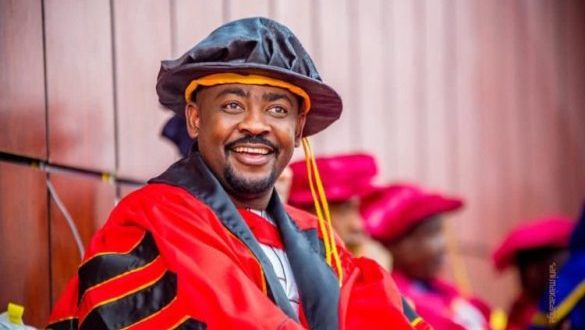
In a country where the conversation around universities often ends at ASUU strikes, tuition, and graduate unemployment, Prof. Adamu Gwarzo decided to change the script entirely. He did not wait for the system to fix itself. He built a new one. At a time when most people his age were still climbing the academic ladder, he was already founding institutions. Today, he owns three centres of learning and he incubates 3 ivory towers that are reshaping what higher education means in Nigeria and across West Africa. That is why I describe him as, “The Wizkid of Nigeria’s University Entrepreneurship.” and many in the education circle now call him so.
Young in vision, disruptive in approach, and already a legend in results.
Prof. Gwarzo’s story is not the story of inheritance. It is the story of intention. He looked at the gap between what universities produce and what the economy demands, and he decided to bridge it. The first proof of that vision is the Maryam Abacha American University of Nigeria, MAAUN, in Kano. It was not built to be just another private university. It was built to be American in curriculum, African in context, and Nigerian in ambition. English as the language of instruction, a credit system, and a heavy emphasis on entrepreneurship became the foundation. From Kano, the vision crossed borders. The Maryam Abacha American University of Niger in Maradi followed, becoming one of the first Nigerian-owned universities to establish a strong footprint in the Francophone world.
Then came the Franco-British International University, FBIU, in Kaduna. Three centres of learning, three different models, one philosophy: produce graduates who can create wealth, not just look for jobs.
To own a university is one thing. To incubate it is another. And this is where Prof. Gwarzo separates himself from the pack. Incubation means nurture. It means building systems that outlive the founder. It means looking beyond buildings and admission quotas to ask: what kind of human being is walking out of these gates? At MAAUN Kano, MAAUN Maradi, and FBIU Kaduna, the answer is clear. Students are taught to think like owners.
In his universities, entrepreneurship is not an elective. It is woven into the curriculum. From 100 level, students are exposed to business development, innovation labs, and industry partnerships. The idea is simple. A graduate of these institutions should be able to write a Curriculum Vitae, CV, and also write a business plan.
That philosophy is already producing results. In Kano, MAAUN has become a hub for students from across the North and beyond who want an international-standard education without leaving the country.
In Maradi, Niger Republic, the university has become a bridge between Nigeria and Niger, training bilingual graduates who can work in both Anglophone and Francophone economies. In Kaduna, FBIU is positioning itself as the link between Nigerian students and European academic standards, with partnerships that allow for exchange and dual certification.
So what we have arising from his vision are three universities, three countries in influence, one founder incubating them all.
Prof. Gwarzo understands that a university in 2026 cannot survive on lectures alone. It must be connected to industry, to technology, and to the real problems of society. That is why he has pushed for partnerships with international institutions, tech companies, and development agencies.
As it stands today, students from his universities are doing internships in Dubai, United Arab Emirate, Turkey in Europe and across Africa. Research is being directed toward agriculture, health, and renewable energy — the sectors that will employ the next generation.
This young man building the future of his students also insists on discipline, global best practices, and zero tolerance for cultism and examination malpractice. The message to staff and students is consistent: we are not here to play school. We are here to build a future.
What makes the “Wizkid” tag stick is not just the speed of growth. It is the creativity. Like Wizkid changed Afrobeats music by blending local sound with global appeal, Prof. Adamu Gwarzo is changing Nigerian university education by blending global standards with local realities.
That the narrative around the standard and quality of University education in Nigeria and West Africa subregion is obviously an understatement now.
As an educationist with eyes for the bigger picture, he saw that parents were spending millions to send children abroad, and he asked: why not bring the abroad here? He saw that graduates were jobless, and he asked: why not teach them to be employers? He saw that Nigerian universities were isolated, and he asked: why not build campuses that speak to two languages, two cultures, two economies?
The impact goes beyond the classroom. Thousands of jobs have been created directly through the construction, staffing, and running of the three institutions. Thousands more are being created indirectly as graduates start businesses, as vendors supply the campuses, and as host communities benefit from the economic activity.
In Kano, Maradi, and Kaduna, these universities have become mini-economies of their own. That is the power of incubation. It does not just grow a school. It grows a community.
Critics will ask if it is sustainable. The numbers suggest yes. Enrollment is growing. Partnerships are expanding. Alumni are beginning to show up in government, in business, and in academia.
But more than the numbers, it is the mindset that Prof. Gwarzo has introduced. For too long, Nigerian education has been about certificates. He has made it about capacity. For too long, universities have been ivory towers cut off from society. He has made them incubators plugged directly into the economy.
Nigeria’s biggest challenge is not a lack of young people. It is a lack of prepared young people. Prof. Gwarzo is attacking that problem at the source. He believes that if you fix the university, you fix the graduate. If you fix the graduate, you fix unemployment. If you fix unemployment, you fix insecurity, migration, and hopelessness. It is an ambitious chain, but he is building the first link himself, three times over.
The title “Wizkid of Nigeria’s University Entrepreneurship” may sound like hype. But in an industry that moves slowly, he has moved fast. In a sector that resists change, he has forced it. In a country that exports students, he is importing standards. He owns three centres of learning. He incubates three ivory towers. And he is doing it with the energy of someone who knows that education is the only real wealth a nation can bank on.
Years from now, when people talk about the transformation of private university education in Nigeria, Prof. Adamu Gwarzo’s name will come up early. Not because he owned universities, but because he redefined what they are for. Not because he built campuses, but because he built graduates who can build nations.
That is leadership. That is vision. That is the Wizkid of Nigeria’s University Entrepreneurship at work.